Short Overview
ToggleVoice Overview
An MBBR system cleans wastewater with the help of tiny living organisms. These organisms grow on small plastic carriers that move inside a tank. As wastewater passes through the tank, the organisms break down pollutants and help make the water cleaner.
What Does MBBR Mean?
MBBR means Moving Bed Biofilm Reactor. It is a biological wastewater treatment process. This means that helpful microorganisms do much of the cleaning work. They use unwanted organic matter in wastewater as food.
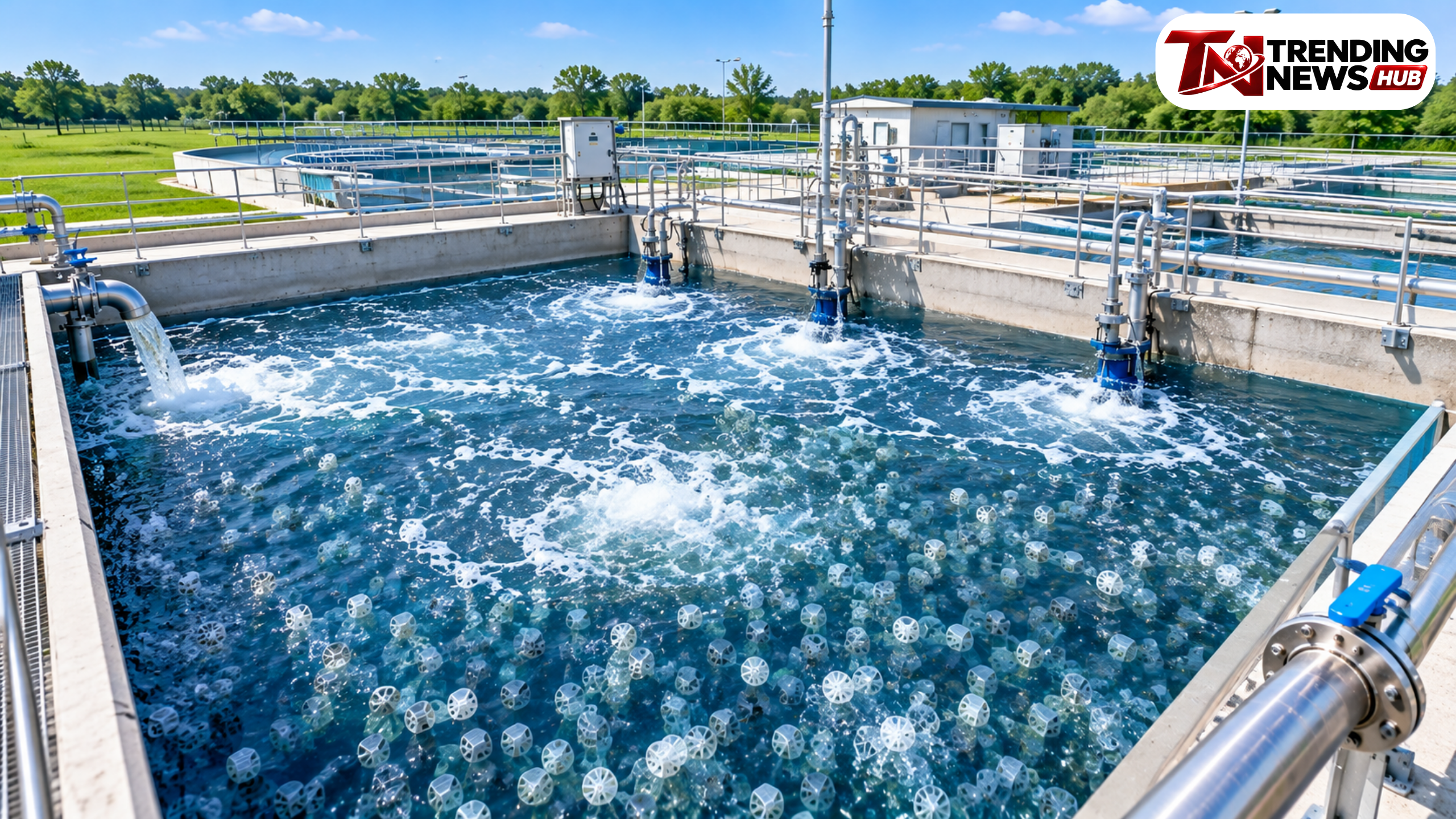
The system uses a tank filled partly with moving carrier media. A thin layer of microorganisms, called biofilm, grows on the carriers. Air or mechanical mixers keep the carriers moving so that wastewater can touch the biofilm.
- Moving bed
- Biofilm
- Reactor
The word moving describes the carrier media. Biofilm describes the living layer on the media. Reactor means the tank where the treatment takes place.
How Does an MBBR System Work?
Wastewater first enters the treatment plant. Large rubbish and heavy solids are removed before the water reaches the MBBR tank. This protects the equipment and gives the biological process better conditions.
Inside the tank, microorganisms grow on the carrier media. Air bubbles or mechanical mixers move the media through the water. The microorganisms then break down biodegradable material and may also help remove ammonia and nitrogen.
- Wastewater enters the plant
- Large solids are removed
- Water enters the MBBR tank
- Bacteria grow on the carrier media
- Air or mixers move the media
- The biofilm breaks down pollutants
- A screen keeps the media inside
- Treated water moves to the next stage
The process is simple to picture. The carriers act like small homes for helpful bacteria. The wastewater flows around these homes, and the bacteria use pollutants in the water as food.
Main Parts of an MBBR System
An MBBR system has several important parts. Each part has a clear job. The tank holds the water and media. The media give bacteria a place to grow. The air system adds oxygen and keeps the media moving. The screen stops the media from leaving the tank.
- MBBR tank
- Biofilm carriers
- Aeration system
- Retention screen
- Water inlet
- Water outlet
A complete wastewater plant may also contain screening, grit removal, settling, filtration and disinfection. MBBR is often one part of a larger treatment process, not the entire plant.
What Is MBBR Media?
MBBR media is the small carrier material placed inside the reactor tank. It is usually made from a durable plastic. Its shape gives bacteria a surface where they can attach and grow.
The carriers are designed to move through the water. They are light enough to be mixed by air or mechanical movement. Their internal shape may also protect the biofilm from strong turbulence.
- Carrier surface
- Growing biofilm
- Open water flow
- Protected inner areas
Different carriers have different shapes, sizes and surface areas. A larger stated surface area does not automatically mean better treatment. The final result also depends on the wastewater, loading, oxygen, mixing and system design.
How Does the MBBR Biofilm Work?
A biofilm is a thin layer of microorganisms attached to a surface. In an MBBR tank, the surface is the carrier media. The biofilm contains different microorganisms that can perform different jobs.
The outer part of the biofilm may receive more oxygen and food. Deeper parts may receive less oxygen. This can allow different biological reactions to happen in different parts of the same biofilm. However, the exact result depends on the carrier, loading and operating conditions.
- Bacteria attach
- Biofilm develops
- Pollutants reach the biofilm
- Bacteria use the pollutants
- Old growth leaves the carrier
As the biofilm grows, movement creates natural rubbing forces. These forces can remove some old or weak growth. This helps prevent the biofilm from becoming too thick, although the detached material still needs to be separated later.
What Does the Aeration System Do?
In an aerobic MBBR system, the aeration system sends air into the tank. The air provides oxygen for microorganisms and helps move the carrier media through the wastewater.
Air usually enters through diffusers near the bottom of the tank. The rising bubbles create water movement. This movement helps keep the carriers mixed and improves contact between the water, oxygen and biofilm.
- Adds oxygen
- Moves the carriers
- Mixes the tank
- Supports aerobic bacteria
The air system must be designed for the real treatment demand. Too little air may reduce treatment and stop the carriers from moving properly. Too much air may waste energy and create unnecessary turbulence.
How Does MBBR Remove BOD and COD?
BOD means biochemical oxygen demand. COD means chemical oxygen demand. Both terms describe pollution linked to organic material in wastewater, although they are measured in different ways.
Microorganisms in the biofilm consume biodegradable organic material. This reduces the amount of organic pollution left in the water. The treated water usually moves to another stage where remaining solids are separated.
- Organic matter enters
- Bacteria consume it
- BOD can decrease
- COD can decrease
- Solids leave later
The amount removed cannot be promised from the word MBBR alone. Results depend on wastewater strength, temperature, flow, tank volume, oxygen and the target discharge quality.
Can MBBR Remove Ammonia and Nitrogen?
Yes, an MBBR system can be designed for ammonia and nitrogen removal. Ammonia removal often needs nitrifying microorganisms and enough oxygen. These microorganisms convert ammonia into nitrite and then nitrate.
Nitrogen removal may need more than one biological condition. An aerobic area can support nitrification. An anoxic area can support denitrification, where nitrate may be changed into nitrogen gas.
- Ammonia enters
- Nitrifying bacteria act
- Nitrate can form
- Anoxic treatment may follow
- Nitrogen gas can leave
Not every MBBR plant removes nitrogen. The plant must be designed for that purpose. The required tanks, oxygen conditions, carbon supply and control methods must match the treatment target.
What Is an MBBR Retention Screen?
A retention screen is fitted near the outlet of the MBBR tank. It allows water to leave while keeping the plastic carriers inside the reactor.
Without this screen, the media could travel into pipes, pumps or later treatment units. The screen must be strong enough for the flow and must have openings that prevent the selected carriers from escaping.
- Holds carriers inside
- Allows water through
- Protects downstream equipment
- Needs regular inspection
A blocked screen can reduce flow. A damaged screen can allow media to escape. For this reason, screen condition is an important part of MBBR operation and maintenance.
MBBR Process Flow Diagram
A simple MBBR wastewater treatment flow may look like this:
Wastewater inlet Screening Primary treatment MBBR tank Solids separation Filtration or disinfection Final outlet
The exact flow can change from one plant to another. Some plants use several MBBR tanks. One tank may remove organic matter, while another may support nitrification or denitrification.
- Inlet treatment
- Biological treatment
- Solids separation
- Final polishing
MBBR is often used with other treatment methods. The complete treatment train depends on the wastewater and the quality required at the final outlet.
Video Guide
Aerobic Anoxic and Anaerobic MBBR
MBBR is not limited to one operating condition. The reactor may be aerobic, anoxic or anaerobic. These words describe the oxygen conditions inside the tank.
An aerobic MBBR uses air. An anoxic MBBR usually uses mixing without normal aeration. An anaerobic MBBR works without oxygen and nitrate as the main electron acceptors. These systems have different biological goals and must not be treated as identical.
| Type | Main condition | Common purpose |
| Aerobic MBBR | Oxygen is added | Organic matter and ammonia treatment |
| Anoxic MBBR | Little or no added oxygen | Denitrification |
| Anaerobic MBBR | No oxygen and no nitrate as the main acceptor | Specialised industrial treatment |
The choice depends on the wastewater and the treatment target. A normal aerobic sewage plant should not be described as an anaerobic MBBR.
How Is an MBBR System Designed?
MBBR design begins with wastewater information. Engineers need to know the flow, pollutant levels, temperature and required final quality. They then select the tank size, carrier type, media amount, air system and screen arrangement.
Design should be completed by a qualified wastewater professional. A simple online calculator cannot replace proper testing, process selection and engineering checks.
- Wastewater flow
- BOD and COD load
- Ammonia load
- Nitrogen target
- Water temperature
- Carrier surface area
- Media fill level
- Oxygen demand
- Mixing requirement
- Final solids separation
MBBR design calculations often use surface area loading. In simple terms, this compares the pollutant load with the useful carrier surface available for biofilm growth. The correct value depends on the carrier and the biological treatment goal.
Benefits of MBBR Treatment
MBBR can be useful when a plant needs more biological treatment in limited space. The carriers hold a large amount of attached biomass inside the reactor. This can help a plant increase treatment capacity or upgrade an existing tank.
MBBR can also be used in municipal plants, industrial plants and packaged systems. Veolia describes applications for municipal and industrial wastewater and notes that MBBR can be used in aerobic, anoxic and anaerobic processes.
- Compact treatment area
- Flexible tank design
- Useful for plant upgrades
- No normal sludge return in the MBBR stage
- Can support nitrogen treatment
- Suitable for many applications
These are general benefits, not promises for every project. A real plant may face problems with air use, screening, solids separation or changing wastewater conditions.
Limits of MBBR Treatment
MBBR is not a magic box. It needs good design and proper operation. The media must move correctly, the air or mixer must work, and the retention screens must remain clear.
The water may also need pre-treatment before it reaches the reactor. Large solids, grease or toxic substances can damage equipment or harm the microorganisms.
- Needs reliable mixing
- Needs suitable pre treatment
- Screens can block
- Detached biofilm needs separation
- Air use can be high
- Industrial wastewater may need testing
MBBR also does not remove every pollutant. Biological treatment is mainly used for biodegradable organic matter and selected nitrogen processes. Other pollutants may require physical, chemical or membrane treatment.
MBBR Compared With Activated Sludge
MBBR and activated sludge both use microorganisms to treat wastewater. The main difference is where much of the biomass grows. In activated sludge, microorganisms mainly remain suspended in the water. In MBBR, much of the biomass grows on moving carriers.
MBBR may be easier to add to an existing tank because media can be placed inside a suitable reactor. However, each project must be checked carefully before a process is selected.
| Feature | MBBR | Activated sludge |
| Main biomass location | On moving carriers | Suspended in the water |
| Carrier media | Used | Not normally used |
| Air system | Adds oxygen and moves media | Adds oxygen and mixes water |
| Sludge return | Not normally needed for the MBBR stage | Commonly used |
| Main design focus | Media and biofilm | Sludge age and settling |
| Upgrade use | Often suitable for capacity upgrades | May need more tank volume |
IFAS is a related hybrid process. It uses both suspended sludge and attached-growth media. It should not automatically be called the same as a standard MBBR system.
Where Is MBBR Used?
MBBR is used in many types of wastewater treatment. It can treat municipal sewage and industrial wastewater when the system is designed for the particular flow and pollutants.
Industrial examples may include food and drink production, dairy processing, pulp and paper, chemicals and other manufacturing activities. The correct process depends on the actual wastewater, not simply the industry name.
- Municipal sewage
- Food and drink wastewater
- Dairy wastewater
- Pulp and paper wastewater
- Chemical wastewater
- Small packaged plants
MBBR can also be used to upgrade an existing plant. Adding carriers to a suitable tank may increase biological capacity without building a completely new tank. This still requires engineering checks.
MBBR Operation and Maintenance
A well-designed system still needs regular checks. Operators should confirm that the media are moving, the air system is working and the screens are not blocked.
They should also monitor the incoming and outgoing water. Changes in flow, temperature, pH or pollutant strength can affect the microorganisms.
- Check carrier movement
- Inspect retention screens
- Check blowers and diffusers
- Monitor oxygen when required
- Watch for unusual foam
- Record water quality results
- Remove separated solids
The exact operating values should come from the plant design and operating manual. There is no single oxygen level, media fill level or air rate that is correct for every MBBR system.
Frequently Asked Questions
What is an MBBR system?
An MBBR system is a biological wastewater treatment process. It uses moving plastic carriers where microorganisms grow. The microorganisms break down pollutants in the wastewater.
How does an MBBR system work?
Wastewater enters a tank containing moving carrier media. Air or mixers keep the media moving. Bacteria on the media consume pollutants, and a screen keeps the carriers inside the tank.
What is MBBR media?
MBBR media is the carrier material placed in the biological tank. It gives microorganisms a surface where they can grow and form a biofilm.
Is MBBR aerobic or anaerobic?
MBBR can be aerobic, anoxic or anaerobic. Many systems are aerobic, but the correct type depends on the treatment goal and tank conditions.
Is MBBR the same as MBR?
No. MBBR uses moving biofilm carriers. MBR uses membrane filtration together with biological treatment. The two systems have different designs.
Final Answer Is MBBR Right for You?
MBBR works by giving helpful microorganisms a moving surface where they can grow. Air or mixers move the carriers, the biofilm treats the wastewater, and a screen keeps the carriers inside the tank.
The system can support organic matter removal, ammonia treatment and nitrogen removal when it is designed for those purposes. It can also help upgrade plants where space is limited. However, the correct design depends on real wastewater data, engineering checks and local discharge requirements.
The best article about MBBR should explain both its strengths and its limits. It should not promise that every MBBR plant will produce the same result. Clear facts, careful sourcing and honest limits are more useful to readers than exaggerated claims.
Click to home page read more least updates for UK.